
Blog
Replacement Cost vs Actual Cash Value: How Insurers Value Equipment Losses
Replacement cost and actual cash value produce very different payouts on the same equipment loss, and the gap often runs into thousands of dollars. This guide breaks down both formulas, explains the coinsurance penalty that catches underinsured owners, and shows how a documented appraisal supports whichever basis your policy uses.
When a forklift burns in a warehouse fire or a CNC machine is destroyed in a flood, the insurance payout depends entirely on which valuation method the policy uses. Replacement cost and actual cash value can produce settlement figures that differ by tens of thousands of dollars on the exact same piece of equipment. Understanding both formulas, and knowing which one applies to your policy, is the difference between a claim that makes you whole and one that leaves you short. Our equipment appraisal for insurance claims work exists precisely because policyholders need documented, defensible numbers before a loss happens, not after.
What Is Replacement Cost Value for Equipment?
Replacement cost value (RCV) is the amount it takes to replace damaged or destroyed equipment with a new item of comparable kind and quality, at today's prices, with no deduction for wear or age. Investopedia defines replacement cost as the cost of restoring property to its pre-damage condition regardless of the property's actual value at the time of loss. For equipment, that means pricing a new, functionally equivalent machine, plus freight, installation, and any other cost necessary to get it back into service.
RCV coverage typically costs more in premium because it exposes the insurer to a higher payout. It is also generally more available on newer equipment. Insurers are less willing to extend full replacement cost treatment to machinery that is already near the end of its useful life, since the gap between a worn-out unit and a brand-new equivalent can be enormous.
What Is Actual Cash Value for Equipment?
Actual cash value (ACV) is most commonly calculated as replacement cost minus depreciation, though some jurisdictions define it instead as fair market value. Progressive describes ACV as the amount to replace damaged or stolen property minus depreciation at the time of the loss. The formula looks simple, but the depreciation piece is where most disputes happen.
Depreciation is generally established by assigning the equipment a useful life, then applying the fraction of that life already consumed to the replacement cost. A piece of equipment with a 10-year useful life that is 6 years old has roughly 4 years of remaining life, so 60% of its replacement cost is treated as depreciation and 40% survives as ACV. Some state insurance rules build this directly into their statutory definitions. Maine, for example, requires that physical depreciation be determined according to standard business practices, which for equipment usually means recognized useful-life tables, condition ratings, and documented age and use data rather than an arbitrary haircut. Iowa's insurance rules take a slightly different approach, allowing insurers to calculate ACV either as replacement cost minus depreciation or as market value, which means the exact number can shift depending on which method the carrier chooses.
Watch out: ACV is not a single fixed formula everywhere. Two adjusters looking at the same machine can land on different numbers depending on whether their state or policy treats ACV as a depreciation calculation or a market-value estimate.
Replacement Cost vs. Actual Cash Value: A Side-by-Side Comparison
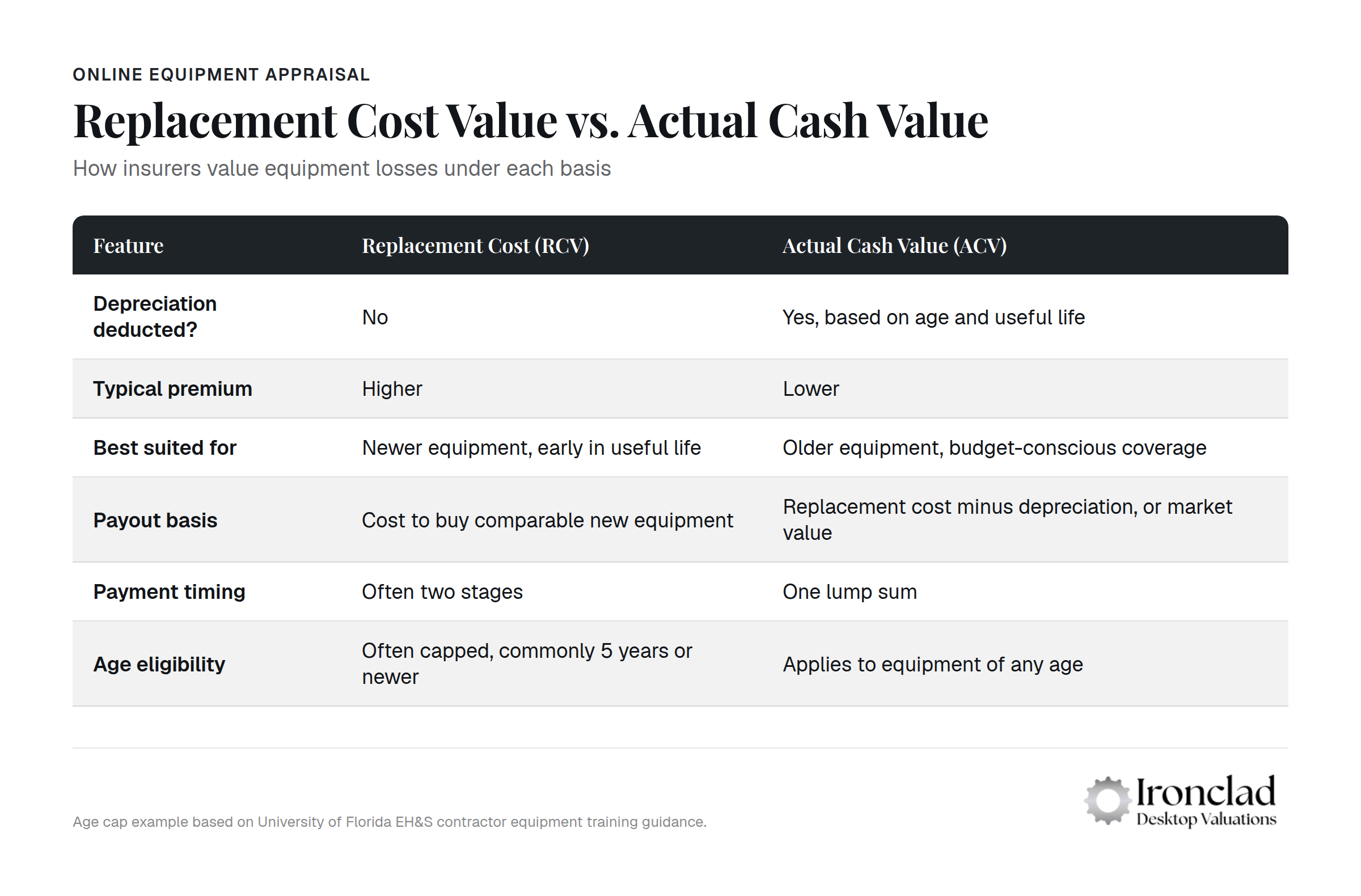
The practical difference between the two bases shows up most clearly when you line them up against each other.
| Feature | Replacement Cost Value (RCV) | Actual Cash Value (ACV) |
|---|---|---|
| Depreciation deducted? | No | Yes, based on age and useful life |
| Typical premium | Higher | Lower |
| Best suited for | Newer equipment still early in its useful life | Older equipment, budget-conscious coverage |
| Payout basis | Cost to buy comparable new equipment today | Replacement cost minus depreciation, or market value |
| Payment timing | Often paid in two stages (see below) | Paid in one lump sum |
| Age eligibility | Frequently restricted to equipment under a set age (commonly 5 years) | Applies to equipment of any age |
A common industry practice caps RCV eligibility at a set age threshold, such as treating equipment 5 years old and newer as replacement cost eligible while everything older settles at ACV. Owners of aging fleets or long-lived machinery should assume ACV applies unless their policy explicitly states otherwise.
Why Reproduction Cost Rarely Applies to Equipment
Reproduction cost, the cost to recreate an item using the same materials and methods as the original, matters for fine art, antiques, and irreplaceable objects. It has almost no application to commercial equipment. A 15-year-old lathe or a discontinued packaging line does not need to be rebuilt with identical, possibly obsolete components; it needs to be replaced with a modern equivalent that performs the same function. Reproduction cost only becomes relevant when the item itself is the source of value, such as an artist's original piece or a one-of-a-kind object where no functional substitute exists. For nearly every equipment claim, replacement cost and actual cash value are the two bases that matter, and reproduction cost stays a footnote reserved for personal property and collectibles.
The Two-Payment Structure Under RCV Policies
Most RCV endorsements do not pay the full replacement amount upfront. Instead, they use a two-stage structure that protects the insurer against paying full replacement value for equipment that never actually gets replaced.
- Initial Payment at Actual Cash Value
- The insurer first pays the ACV of the damaged equipment, which reflects depreciation, exactly as it would under a standard ACV-only policy.
- Replacement and Documentation
- The policyholder repairs or replaces the equipment, typically within a window specified in the policy, and submits proof of the actual expenditure.
- Supplemental Payment for the Difference
- Once replacement is documented, the insurer pays the remainder, the gap between the ACV already paid and the full replacement cost actually incurred.
This structure means owners carrying RCV coverage should not expect a single check for the full replacement amount. Cash flow planning matters: the business needs to front the difference between the ACV check and the true cost of a new machine before the supplemental payment arrives.
How Coinsurance Clauses Penalize Underinsured Equipment
Coinsurance clauses require the policyholder to insure equipment for a minimum percentage, commonly 80% or 90%, of its full replacement cost. If the equipment is insured below that threshold at the time of loss, the insurer reduces the claim payment using a coinsurance penalty formula, even on a partial loss. This single clause causes more underpayment surprises than almost any other feature of an equipment policy, because owners rarely update their coverage limits as replacement costs rise with inflation. Rising equipment and materials prices mean a limit set several years ago can fall well short of the true replacement cost at the time of a claim, pushing an owner into a coinsurance penalty without ever changing their coverage decision.
Worked Example: ACV Calculation With a Coinsurance Penalty
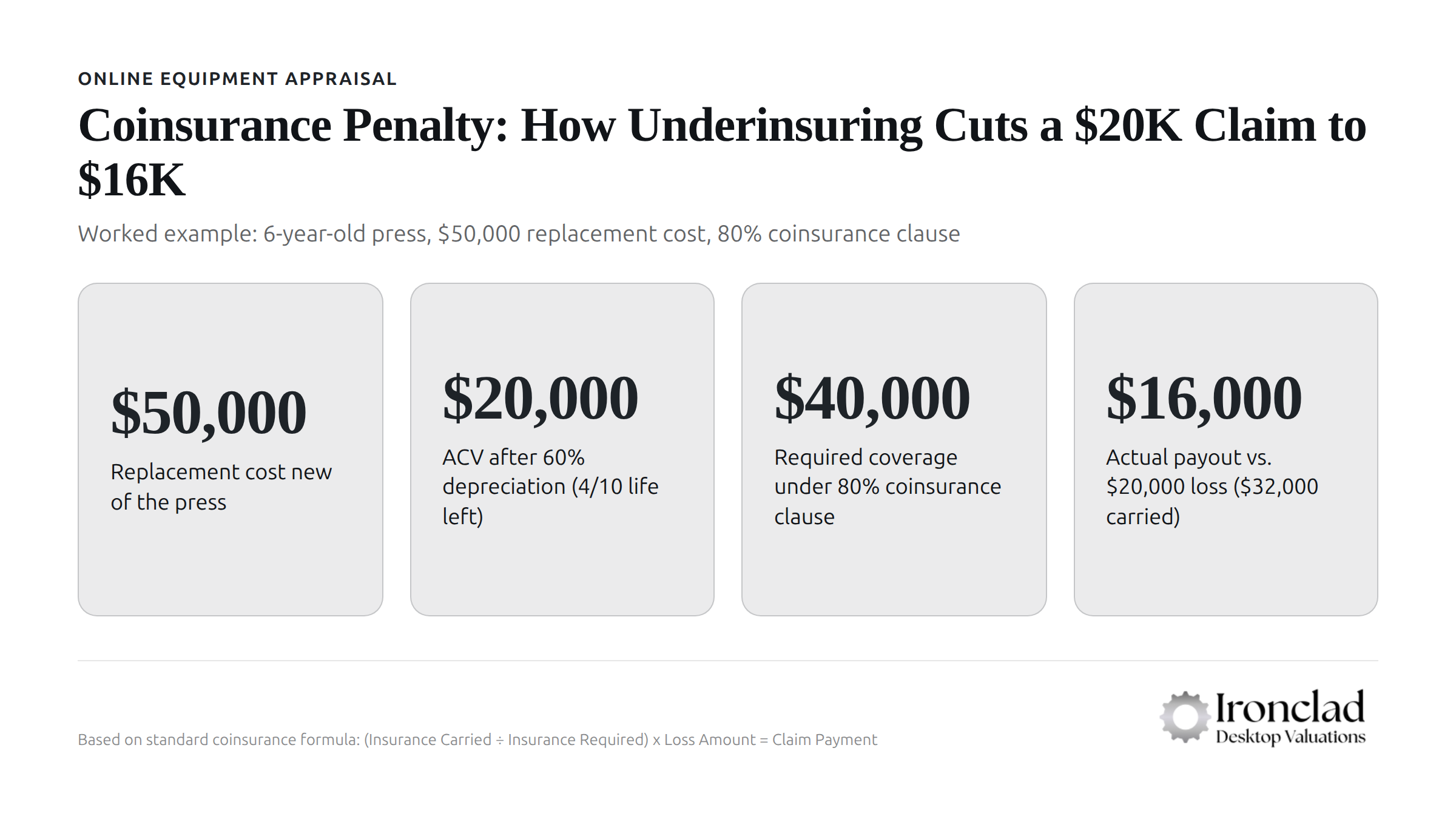
Example: A print shop owns a commercial press with a replacement cost new of $50,000. The press is 6 years old, with a 10-year useful life, so 4 years of useful life remain.
Step 1: Calculate depreciation. Remaining life is 4/10, or 40%, so ACV equals 40% of replacement cost: $50,000 x 0.40 = $20,000. Depreciation taken is $30,000.
Step 2: Apply the coinsurance requirement. The policy carries an 80% coinsurance clause, based on the equipment's full replacement cost of $50,000. That means the required limit is $40,000 (80% x $50,000). The owner had only insured the press for $32,000, which is 80% of the required limit.
Step 3: Calculate the coinsurance penalty on the loss. The press suffers a partial loss valued at $20,000 in damage. The standard coinsurance formula is:
(Amount of Insurance Carried ÷ Amount of Insurance Required) x Loss Amount = Claim Payment
($32,000 ÷ $40,000) x $20,000 = $16,000.
Instead of the full $20,000 loss, the shop receives $16,000, a $4,000 shortfall caused entirely by carrying less coverage than the coinsurance clause required. Being underinsured did not just reduce coverage proportionally; it reduced the payout by more than the shortfall in the limit itself.
Key takeaway: Coinsurance penalties apply even on partial losses, not just total losses, which is why insurance limits need to track current replacement cost, not the original purchase price.
How a Professional Equipment Appraisal Supports Either Valuation Basis
Whether a policy settles at replacement cost or actual cash value, the insurer needs a defensible number for both the pre-loss value and the loss itself, and that number is exactly what a qualified appraisal provides. A professional appraisal documents the make, model, age, condition, and useful life of each piece of equipment, along with current market data for comparable replacement units. That documentation does three things at claim time: it supports the replacement cost figure the insurer uses, it substantiates the depreciation applied under an ACV formula, and it gives the policyholder independent evidence if the adjuster's number seems too low.
Appraisals also matter before a loss ever happens. Scheduling equipment at an outdated value is one of the most common ways owners end up underinsured and exposed to a coinsurance penalty. A current appraisal, refreshed as equipment ages or replacement costs shift, keeps the insured limit aligned with the coinsurance requirement and removes the guesswork from both sides of the claim. Owners who want to confirm their equipment is valued correctly before a loss can review our desktop equipment appraisal process, which documents condition and market value without the delay of an on-site visit.
Getting the Number Right Before a Claim Happens
Replacement cost and actual cash value are not interchangeable, and the gap between them can be the difference between replacing a machine outright and absorbing a five-figure shortfall. Knowing which basis your policy uses, understanding how depreciation and coinsurance interact, and keeping equipment values current are the three things that protect an owner when a loss actually occurs. A documented, USPAP-compliant appraisal gives both the policyholder and the insurer a shared, defensible starting point, which is usually what turns a contested claim into a straightforward one.
This article is provided for general informational purposes only and does not constitute legal, tax, or financial advice. Readers should consult a qualified attorney, CPA, or licensed insurance professional regarding their specific circumstances.