
Blog
What Is Forced Liquidation Value and When Do Lenders Require It for Equipment Collateral?
Forced liquidation value equipment appraisals estimate what machinery would bring in a compelled, fast-turnaround auction, and lenders lean on that number when a loan is in trouble. This guide explains how forced liquidation value differs from orderly liquidation and fair market value, and when a lender will actually ask for it.
Forced liquidation value equipment appraisals answer a specific question: what would this machinery actually bring if it had to be sold right now, with no time to wait for the right buyer? Lenders don't ask for this number out of caution alone. They ask for it because a loan default puts them in the position of an unwilling seller working against a clock, and the standard measures of value (fair market, even orderly liquidation) stop describing what they'd actually recover.
This guide breaks down what forced liquidation value means, how it's different from orderly liquidation value and fair market value, and the specific circumstances, including SBA collateral requirements, that push a lender to request it instead of a more standard liquidation premise.
What Does Forced Liquidation Value Mean for Equipment?
Forced liquidation value (FLV) is an appraiser's opinion of the gross amount, expressed in money, that a piece of equipment could typically bring at a properly advertised public auction when the seller is compelled to sell immediately, on an as-is, where-is basis, as of a specific date. The buyer is typically responsible for deinstallation and removal costs, and the whole premise assumes urgency rather than patience.
That urgency is the entire point of the standard. FLV isn't a discount applied to a "normal" value; it's a distinct opinion built around a compressed timeline and a narrower pool of buyers who happen to be paying attention when the auction runs.
How Is Forced Liquidation Value Different From Orderly Liquidation and Fair Market Value?
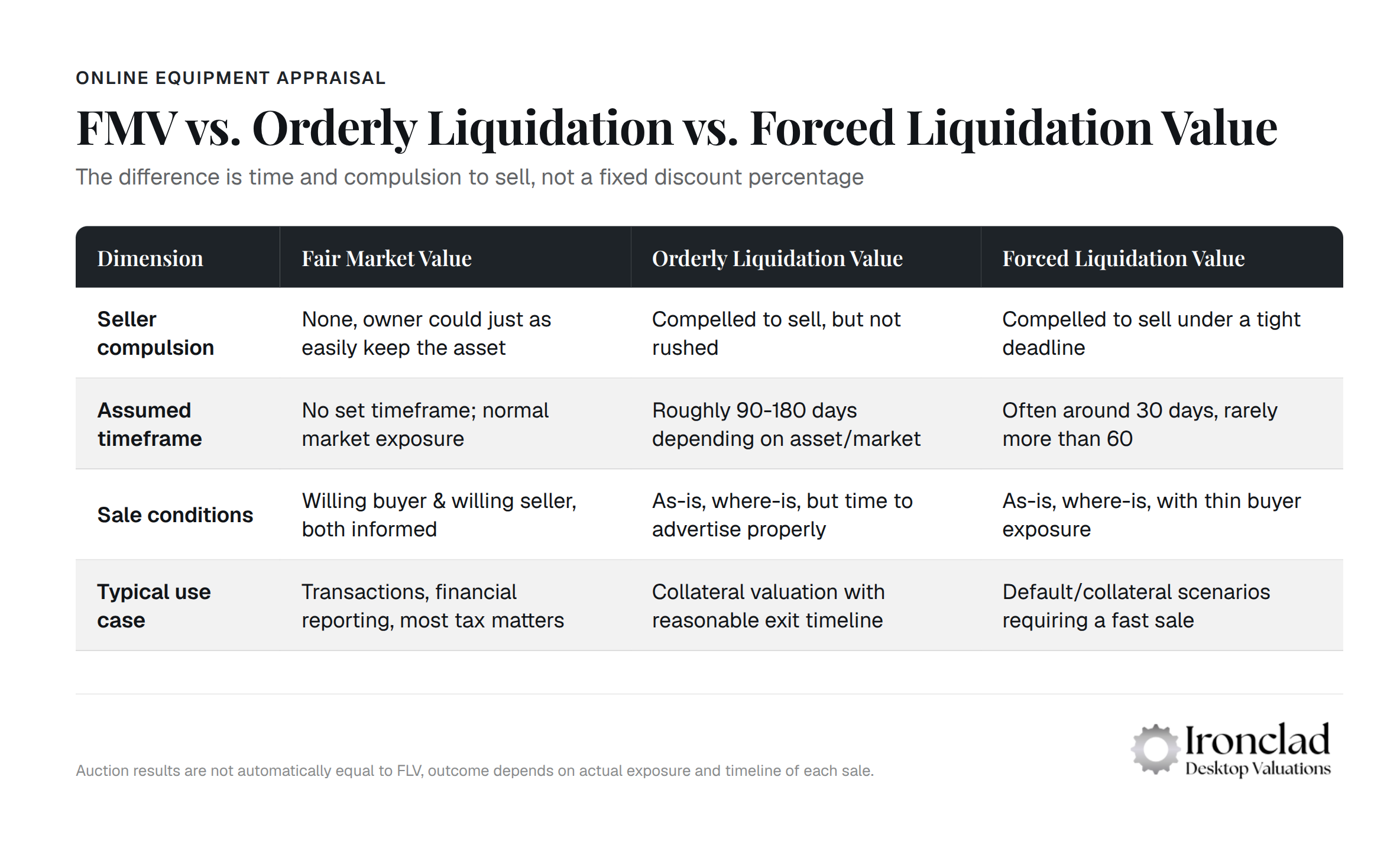
The difference between these three premises comes down to how much time the seller has and whether the seller is compelled to sell at all, not a fixed percentage haircut applied to one number.
- Fair market value (FMV): the price at which equipment would change hands between a willing buyer and a willing seller, neither one under compulsion, both reasonably informed. This is the standard for transactions, financial reporting, and most tax matters. It assumes the owner could just as easily keep the asset, which is exactly why it doesn't fit a collateral or default scenario.
- Orderly liquidation value (OLV): the gross proceeds from a sale where the seller is compelled to sell but has a reasonable period, commonly modeled somewhere in the 90 to 180 day range depending on the asset and market, to find purchasers. The sale is still conducted as-is, where-is, but there's enough time to advertise properly and let buyers come to the table.
- Forced liquidation value (FLV): the same as-is, where-is sale, but modeled over a much shorter window, often around 30 days and rarely more than 60. Less time means a smaller buyer pool has the chance to find out the equipment is for sale, which is the actual driver of a lower result, not some built-in discount rate.
A common mistake is assuming auction results are automatically equal to forced liquidation value. They aren't. Some well-attended, well-advertised auctions produce prices close to fair market value because the equipment is desirable and buyers show up in force. Others land well below FMV because the timeline was tight and exposure was thin. An appraiser has to study the actual circumstances of each sale rather than assume the auction format alone tells the story.
For a full comparison of how orderly liquidation and fair market value apply to equipment appraisals, see our breakdown of orderly liquidation value versus fair market value.
Why Do Lenders Require Forced Liquidation Value?
Lenders request a liquidation-basis value, not fair market value, because they're underwriting the scenario where they end up owning the collateral and need to sell it, not buy or keep it. Fair market value assumes the current owner could retain the asset. A lender holding repossessed equipment has no such luxury: they're trying to recover as much of the loan balance as possible, as fast as reasonably possible.
Most asset-based lenders and banks build their collateral coverage around orderly liquidation value as the standard baseline, since it reflects a realistic, moderately-paced disposition. Forced liquidation value gets requested instead, or in addition, when the lender wants the more conservative downside case:
- The equipment is in poor or functionally limited condition. Machinery that needs repair or has aged out of its original application attracts a smaller, more cautious buyer pool, which makes a compressed sale timeline riskier for recovery.
- The loan is already in workout or default. Once a lender is managing a troubled credit rather than a performing one, the recovery assumption shifts from "we'll have time to do this right" to "we need to know the floor."
- The lender wants a stress case, not just a base case. Some lenders calculate a standard borrowing base off orderly liquidation value, then still request forced liquidation value as a downside check before renewing or restructuring a facility.
None of this has anything to do with the borrower's credit history or how desirable the equipment might be to a future buyer in a normal market. Those factors affect what the equipment is worth; they don't change why the lender is asking for a compelled-sale number instead of a market-based one. For borrowers navigating this directly, our loan collateral appraisal service is built around exactly this kind of scoped, lender-facing engagement.
How Does SBA Guidance Handle Equipment Collateral Valuation?
For SBA 7(a) loans, current SBA guidance generally treats orderly liquidation value as the standard basis for valuing equipment collateral when calculating whether a loan is "fully secured." Used equipment is typically valued at a set percentage of an orderly liquidation appraisal for that calculation.
Forced liquidation value enters the picture when a lender decides the orderly liquidation premise doesn't reflect the real recovery scenario, most often because of equipment condition or a distressed loan situation rather than the loan program itself.
Example: Consider a business closing out an SBA-backed equipment loan where the machinery had sat unused for an extended period and needed repairs before it could run. Because of that functional condition, the lender asked for a forced liquidation valuation rather than the standard orderly liquidation figure used for a routine collateral review. The appraisal still followed the same identification and documentation process (make, model, year, serial number, condition, and location for each asset) but was scoped around the shorter, more urgent sale premise the lender needed for its file.
Watch out: A forced liquidation number is not simply a fixed percentage discount off fair market value or orderly liquidation value. Two pieces of similar equipment in different condition, or located in markets with different buyer depth, can produce very different forced liquidation results even when their fair market values are close.
How Do Appraisers Develop a Forced Liquidation Value?
A defensible forced liquidation appraisal identifies the specific assumptions behind the number, not just a final figure. That means documenting the effective date of value, the intended use and intended user of the report, and the assumed sale venue and marketing period.
Appraisers working under the Uniform Standards of Professional Appraisal Practice (USPAP) are required to define the assignment, establish the effective date, and perform the scope of work necessary to reach a credible conclusion, but USPAP doesn't hand down one universal forced liquidation percentage or a mandatory 30-day window. Those specifics come from the facts of the assignment and the appraiser's judgment, informed by credentialing standards from organizations such as the American Society of Appraisers.
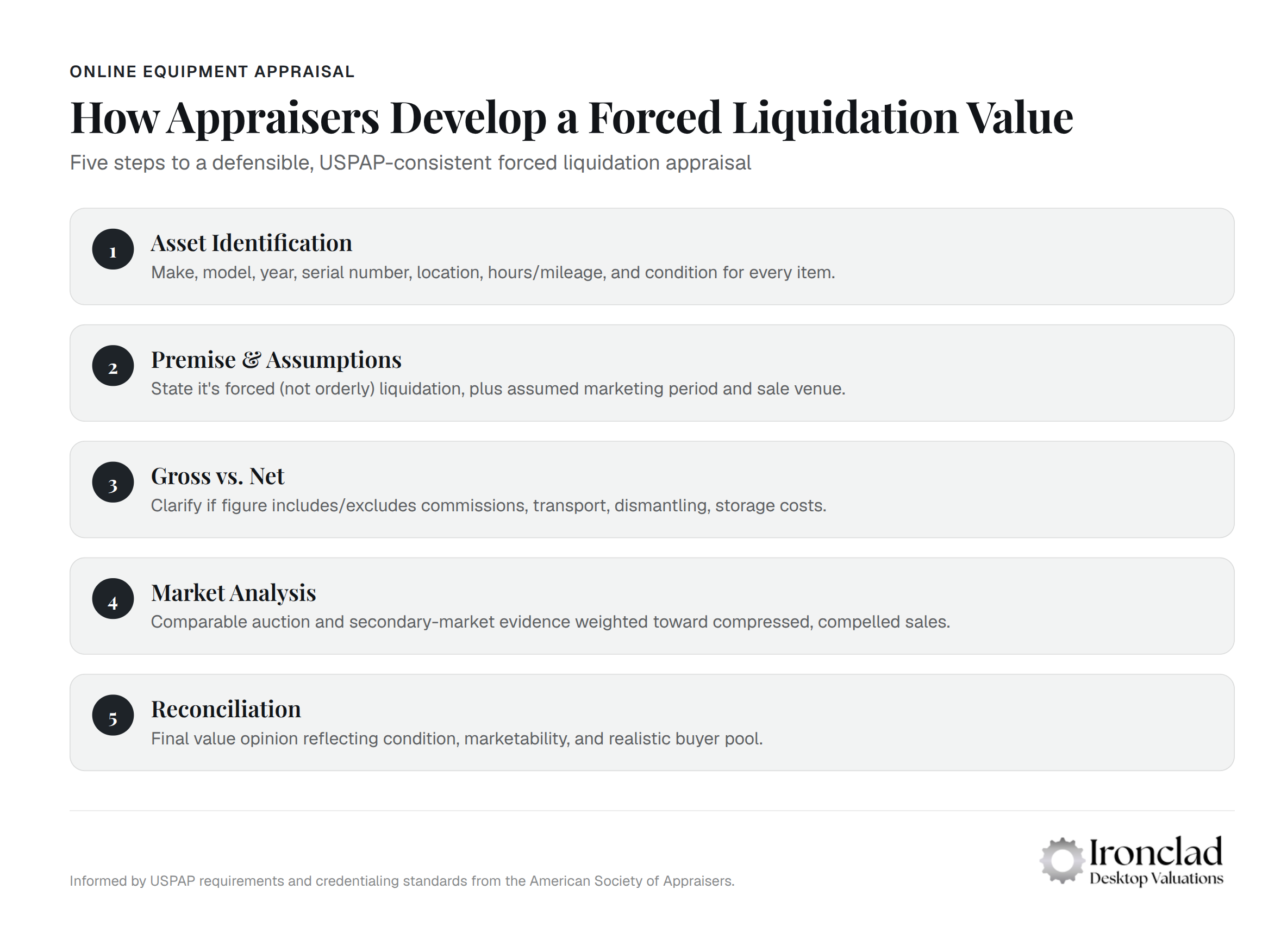
A thorough forced liquidation report typically covers:
- Asset identification. Make, model, year, serial number, location, hours or mileage, and condition for every item in scope.
- Premise and assumptions. A clear statement that the value is forced liquidation, not orderly liquidation or fair market value, along with the assumed marketing period and sale venue (typically a properly advertised public auction).
- Gross versus net. Whether the stated figure includes or excludes commissions, transportation, dismantling, storage, and other disposition costs, since lenders need to know which number they're actually looking at.
- Market analysis. Comparable auction results and secondary-market evidence, weighted toward sales that actually reflect a compressed, compelled-sale environment rather than a well-marketed, long-lead-time disposition.
- Reconciliation. A final opinion of value that accounts for the equipment's condition, marketability, and the realistic buyer pool available within the assumed timeframe.
What This Means for Your Appraisal Cost and Timeline
A forced liquidation valuation for machinery and equipment is quoted as a fixed fee, set after we scope the assignment, never billed hourly. For our machinery and equipment appraisals, standard reports start at $295, IRS-qualified or lender-grade reports start at $395, and most engagements run $695 to $3,000 depending on the number of assets, the quality of existing records, and the depth of market research required. Larger or more complex fleets can run into the $5,000 to $10,000-plus range.
What drives that fee is scope, not the equipment's condition or market value. A forced liquidation report on ten pieces of machinery with clean maintenance records and known serial numbers costs less to produce than the same exercise on eighty pieces of equipment scattered across three facilities with incomplete documentation. The equipment's condition affects the concluded value; it doesn't change what the appraisal itself costs.
If your lender has specified forced liquidation value for a workout, renewal, or collateral closure, or if you're not sure which premise applies, our bankruptcy and forced-sale equipment appraisal service and loan collateral team can scope the assignment and confirm which standard fits before work begins.
This article is provided for general informational purposes only and does not constitute legal, tax, or financial advice. Readers should consult a qualified attorney or CPA regarding their specific circumstances.