
Blog
Cost, Market, and Income Approaches to Valuing Farm Equipment Explained
Farm equipment valuation approaches fall into three categories: cost, market, and income, and knowing which one drives a tractor or combine's appraised value helps lenders, estates, and owners understand the number on the report.
When a lender, an estate executor, or an insurance adjuster asks what a used combine or tractor is actually worth, the answer depends on which of three recognized valuation approaches fits that machine's market position. Farm equipment appraisers are required to consider the cost, sales comparison, and income approaches on every assignment, though not every approach gets developed into a final number. This guide walks through how each one works, when appraisers actually rely on it, and what that means for the tractors, combines, and implements sitting in your operation.
How the Three Standard Valuation Approaches Apply to Farm Machinery
Machinery and equipment appraisal practice, consistent with the Uniform Standards of Professional Appraisal Practice (USPAP), recognizes three approaches to value: the sales comparison (market) approach, the cost approach, and the income approach. Standard 7 of USPAP requires an appraiser to consider all three but does not require developing all three; if an approach is excluded, the appraiser must state why.
For farm equipment, this framework shows up constantly. A bank evaluating loan collateral wants a defensible, current fair market value on a fleet of tractors. An estate settling an estate tax filing needs a value that will hold up to scrutiny. Both situations lean on the same three approaches, just weighted differently depending on what data actually exists for the machine in question.
Our appraisers hold credentials from organizations including the American Society of Appraisers, the Certified Appraisers Guild of America, and NEBB, and every report is prepared in accordance with USPAP regardless of which approach or approaches drive the final conclusion.
The Sales Comparison (Market) Approach for Tractors and Combines
The sales comparison approach estimates value by researching what comparable machines have actually sold for and adjusting for the differences between those machines and the subject. For farm equipment, this is usually the most reliable approach because tractors and combines trade in an active, well-documented secondary market of dealer listings and auction results.
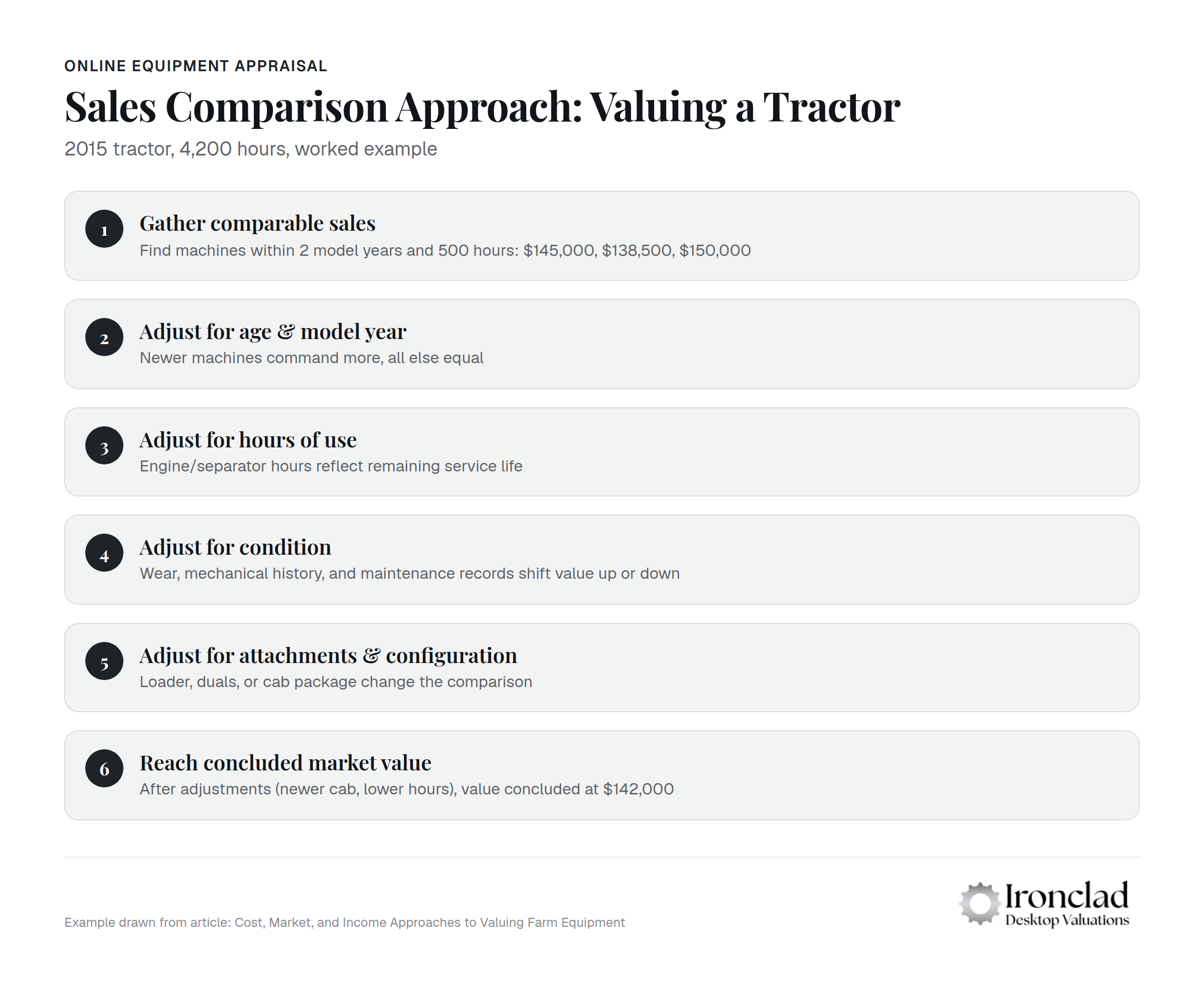
An appraiser working this approach typically gathers a pool of comparable sales and adjusts each one for:
- Age and model year: newer machines command more, all else equal.
- Hours of use: engine hours for a tractor or separator hours for a combine directly affect remaining service life.
- Condition: cosmetic wear, mechanical history, and maintenance records shift the adjustment up or down.
- Attachments and configuration: a combine sold with a corn head and a grain head is not the same asset as a bare chassis, and a tractor with a loader or duals adjusts differently than one without.
Example: A 2015 tractor with 4,200 hours is being appraised for loan collateral. The appraiser locates three comparable sales: $145,000, $138,500, and $150,000, all machines within 2 model years and 500 hours of the subject. After adjusting for a slightly newer cab package on one comparable and lower hours on another, the appraiser concludes a market value of $142,000.
Pro tip: Keep maintenance logs, hour meter photos, and any recent service invoices on hand before an appraisal. Documented condition narrows the adjustment range and gives the appraiser stronger support for the concluded value.
The Cost Approach: Replacement Cost Minus Depreciation
The cost approach starts with the replacement cost new of the equipment (what it would cost to acquire an equivalent new machine today) and then subtracts depreciation to reflect the used condition of the subject asset. This approach matters most when good market comparables are thin, such as for newer machines, custom-configured equipment, or specialized attachments that rarely trade hands.
Appraisers separate depreciation into three distinct categories, and each one tells a different story about why a machine is worth less than a new one:
- Physical deterioration: the loss in value from age, wear, and accumulated hours of use. A combine with 2,800 separator hours has simply worn more than one with 800 hours, regardless of anything else.
- Functional obsolescence: the loss in value from outdated design or technology relative to current equipment. Example: A 15-year-old combine that still runs well mechanically but lacks integrated yield-monitoring and auto-steer capability is functionally obsolete compared to current models, even if its engine and threshing components are in solid physical condition.
- Economic obsolescence: the loss in value from external market conditions outside the machine itself. Example: A sustained downturn in commodity prices reduces farmer demand for large combines and tractors across the board, softening resale values industry-wide, independent of any individual machine's condition.
Example: A 2012 combine has a replacement cost new of $450,000. The appraiser deducts 55% for physical deterioration based on separator hours and age, an additional 10% for functional obsolescence tied to its outdated yield-monitoring system, and 5% for economic obsolescence reflecting a soft grain market. That leaves an indicated value of roughly $135,000 under the cost approach, a figure the appraiser then compares against sales comparison data before reaching a final conclusion.
Cost approach work for farm equipment often references documented recovery periods and depreciation schedules as a cross-check on physical deterioration. Under IRS Modified Accelerated Cost Recovery System (MACRS) rules, new farm machinery placed in service after December 31, 2017 falls into the 5-year property class, while used farm equipment remains in the 7-year class, and both fall into a 10-year class under the Alternative Depreciation System. Publicly available agricultural depreciation calculators typically apply straight-line depreciation over these IRS recovery periods as a simplified planning tool, though appraisers treat that as a cross-check rather than a substitute for a full physical and functional obsolescence analysis.
The Income Approach: Rarely Used for a Single Tractor
The income approach values an asset based on the future economic benefit it is expected to produce, either capitalized as a single number or discounted as a stream of projected cash flows. For most individual pieces of farm equipment, this approach is difficult to apply directly.
The core problem is isolation. A single tractor contributes to a farm's overall income alongside labor, land, seed, weather, and every other input; there is rarely a clean way to attribute a specific dollar figure of farm revenue to that one machine sitting in the shed. Because of that, the income approach is applied far more often to entire income-producing systems than to a lone piece of equipment.
There are situations where it does apply credibly:
- Leased equipment: when a tractor or combine is leased out under a contract with a defined rental payment, that income stream can be capitalized or discounted directly, since the cash flow is contractually isolated from the rest of the farm's operations.
- Integrated income-producing systems: equipment that functions as part of a larger revenue-generating unit, such as a grain handling and drying complex or a dairy milking parlor, sometimes allows an appraiser to model incremental cash flow attributable to that system as a whole, even when a single machine within it cannot be isolated.
Watch out: Be skeptical of any farm equipment valuation that leans heavily on an income approach for a single, unleased machine. Without a contractually isolated cash flow or a clearly defined income-producing system, an income-based number for one tractor or combine is difficult to support and rarely holds up under review.
Why the Market and Cost Approaches Carry the Most Weight
For the great majority of farm equipment appraisals, the sales comparison and cost approaches do the real work, and the income approach gets excluded with a documented reason rather than forced into an assignment where it doesn't fit. This isn't a shortcut; it reflects how USPAP's Standard 7 is meant to function. The appraiser considers all three approaches, develops the ones supported by reliable data, and states plainly why any excluded approach was not developed.
In practice, that means:
- Sales comparison leads whenever an active resale market exists, which covers most common tractors, combines, and standard implements.
- Cost approach supports or substitutes when the subject is newer, highly specialized, or otherwise thin on comparable sales data.
- Income approach appears occasionally, and almost always alongside a lease contract or an integrated income system rather than as the sole basis for a single machine's value.
Comparing the Three Approaches at a Glance
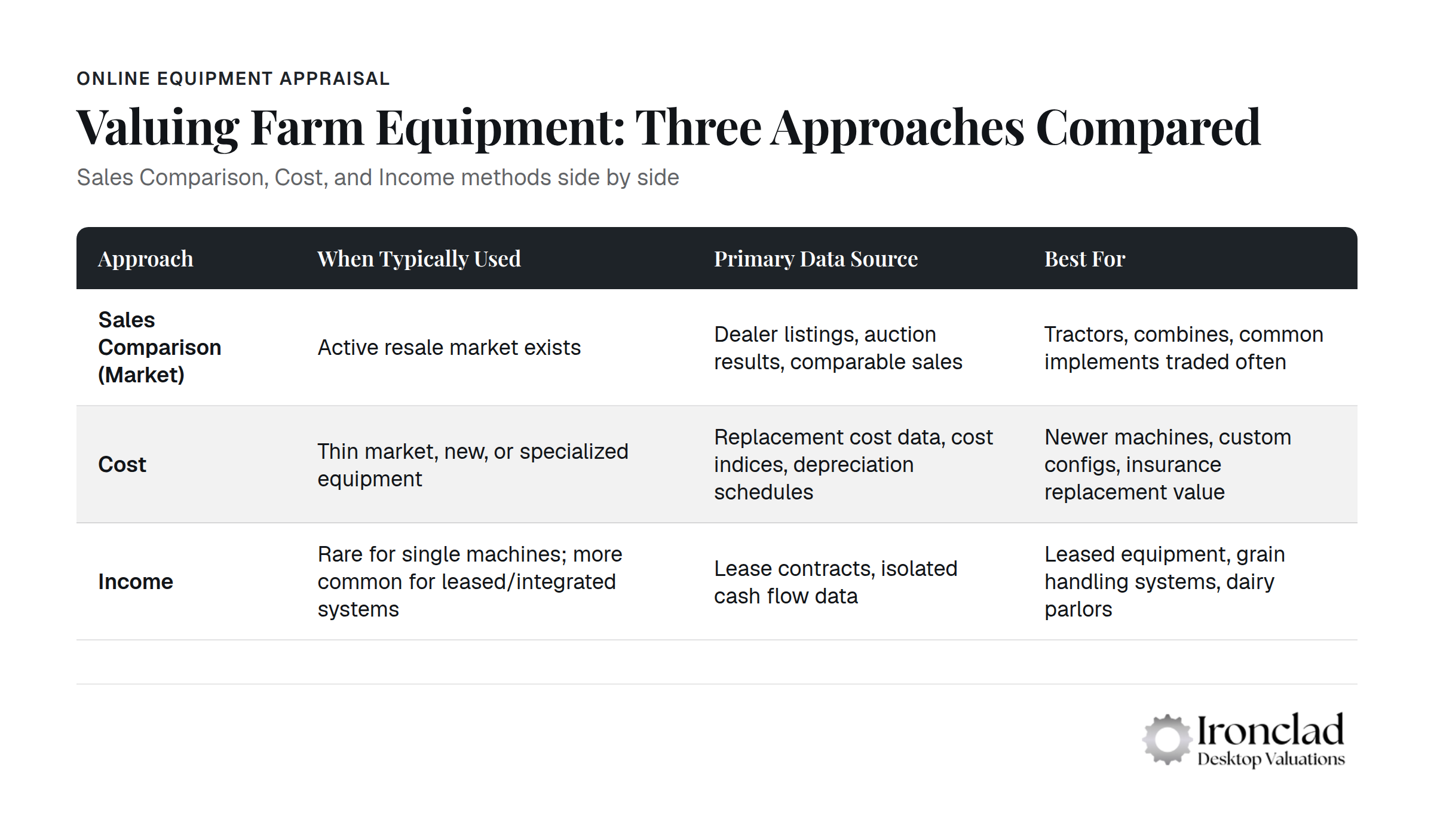
The table below summarizes when each approach typically applies to farm equipment, what data supports it, and which situations it fits best.
| Approach | When Typically Used | Primary Data Source | Best For |
|---|---|---|---|
| Sales Comparison (Market) | Active resale market exists | Dealer listings, auction results, comparable sale records | Tractors, combines, common implements with frequent trading |
| Cost | Thin market, new, or highly specialized equipment | Replacement cost data, cost indices, depreciation schedules | Newer machines, custom configurations, insurance replacement value |
| Income | Rare for a single machine; more common for leased or integrated systems | Lease contracts, isolated cash flow data | Leased equipment, grain handling systems, dairy parlors |
Getting a Defensible Number for your Equipment
A farm equipment appraisal is only as strong as the approach behind it, and a report that explains why the appraiser weighted sales comparison over cost, or excluded income entirely, gives a lender, court, or tax authority something they can actually rely on. Our fees for farm equipment appraisals are quoted as a fixed fee after we scope the assignment, based on the number of machines involved, the intended use of the report, and the depth of analysis required rather than the value of the equipment itself. Standard reports start at $295, IRS-qualified reports start at $395, and most single-machine or small-fleet assignments run between $695 and $2,200, with larger, multi-unit fleet engagements running higher.
If you need a USPAP-compliant valuation for a tractor, combine, or an entire equipment fleet, our farm equipment appraisal service applies the same cost, market, and income framework covered here, tailored to your intended use.