
Blog
How Equipment Is Valued for a Property Tax Appeal: A Cost Approach Walkthrough
Equipment valuation for a property tax appeal comes down to rebuilding the assessor's cost approach and backing it with market evidence. This guide walks through the calculation step by step and shows where outdated depreciation schedules leave businesses overpaying.
Business owners rarely open their personal property tax bill and think the number looks right. Machinery, production lines, and shop equipment depreciate in ways that generic assessor schedules often miss, and the gap between an assessed value and the equipment's actual worth can run into tens of thousands of dollars. This guide explains how equipment is actually valued for a property tax appeal, walks through a real cost approach calculation, and lays out the grounds that hold up when you challenge an assessment.
Our team prepares desktop equipment appraisals for exactly this purpose: rebuilding an assessor's valuation with documented, defensible numbers a board of equalization or hearing officer can actually follow.
Why Equipment Tax Appraisals Work Differently Than the Assessor's Numbers
Most personal property tax assessments come from mass appraisal: a jurisdiction applies a standard cost table and a generic depreciation schedule to thousands of businesses at once, using self-reported asset lists and broad age brackets. It is efficient for the assessor, but it is not built around your specific equipment.
An independent equipment appraisal challenging that assessment follows a different standard entirely. Mass appraisal for tax rolls falls under USPAP Standard 6, while an individual appraisal developed to support or dispute a specific assessment falls under USPAP Standards 7 and 8, the development and reporting standards published by The Appraisal Foundation. That distinction matters because it is precisely the difference an appeal is arguing: a mass-produced number versus an asset-specific one.
Ad valorem equipment appraisals are also retrospective by nature. The valuation date is fixed to the jurisdiction's assessment date, not the date the appraisal is written, which means the appraiser has to reconstruct market and condition data as of that earlier date rather than describe the equipment as it sits today.
Key takeaway: an assessor's number reflects a batch process; an appeal succeeds by showing the individual facts of your equipment that the batch process couldn't capture.
The Administrative Protest Process, Step by Step
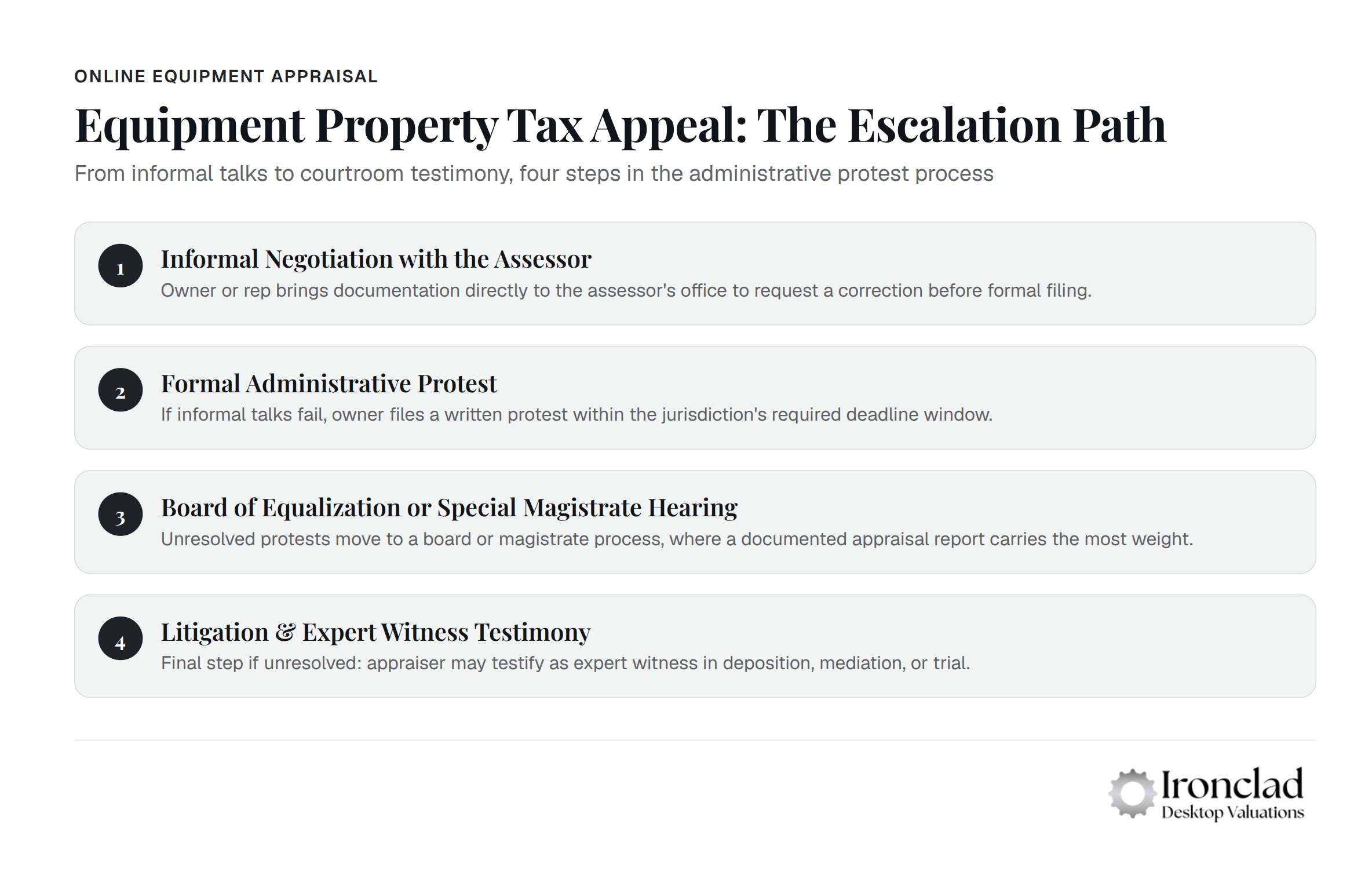
An equipment property tax appeal almost never starts in a courtroom. It starts with a conversation, and it only escalates if that conversation doesn't resolve the disagreement.
- Informal Negotiation with the Assessor's Office
- Most jurisdictions allow a property owner (or their representative, such as a tax consultant or attorney) to bring documentation directly to the assessor and request a correction before any formal filing.
- Formal Administrative Protest
- If informal talks don't resolve the dispute, the owner files a written protest objecting to the assessed value within the jurisdiction's required window. for the specific filing deadline in your jurisdiction, since these vary by state and county.
- Board of Equalization or Special Magistrate Hearing
- An unresolved protest moves to a board of equalization, appeals board, or special magistrate process, depending on what's applicable in that jurisdiction. This is where a documented appraisal report carries the most weight.
- Litigation and Expert Witness Testimony
- If the board process doesn't resolve the dispute, the final step is litigation, where an appraiser may be called to testify as an expert witness in a deposition, mediation, or trial.
Each step depends on having credible, well-documented evidence ready before you need it. A recalculated valuation prepared after the informal conversation has already failed is a much weaker document than one prepared from the start.
The Cost Approach: Rebuilding the Assessor's Number from Scratch
The cost approach is the method most assessors use to generate the original number, and it's also the method an appraiser uses to challenge it. The logic is straightforward: start with what it would cost to reproduce or replace the equipment new, then subtract every form of loss in value the asset has experienced since it was new.
Those deductions fall into three categories:
- Physical deterioration: wear, tear, and use-related decline in the equipment's physical condition.
- Functional obsolescence: a loss in value because the equipment is less efficient, less capable, or technologically outdated compared to what's currently available.
- Economic (external) obsolescence: a loss in value caused by factors outside the equipment itself, such as declining demand for what it produces or new regulatory requirements that limit its use.
A Worked Example
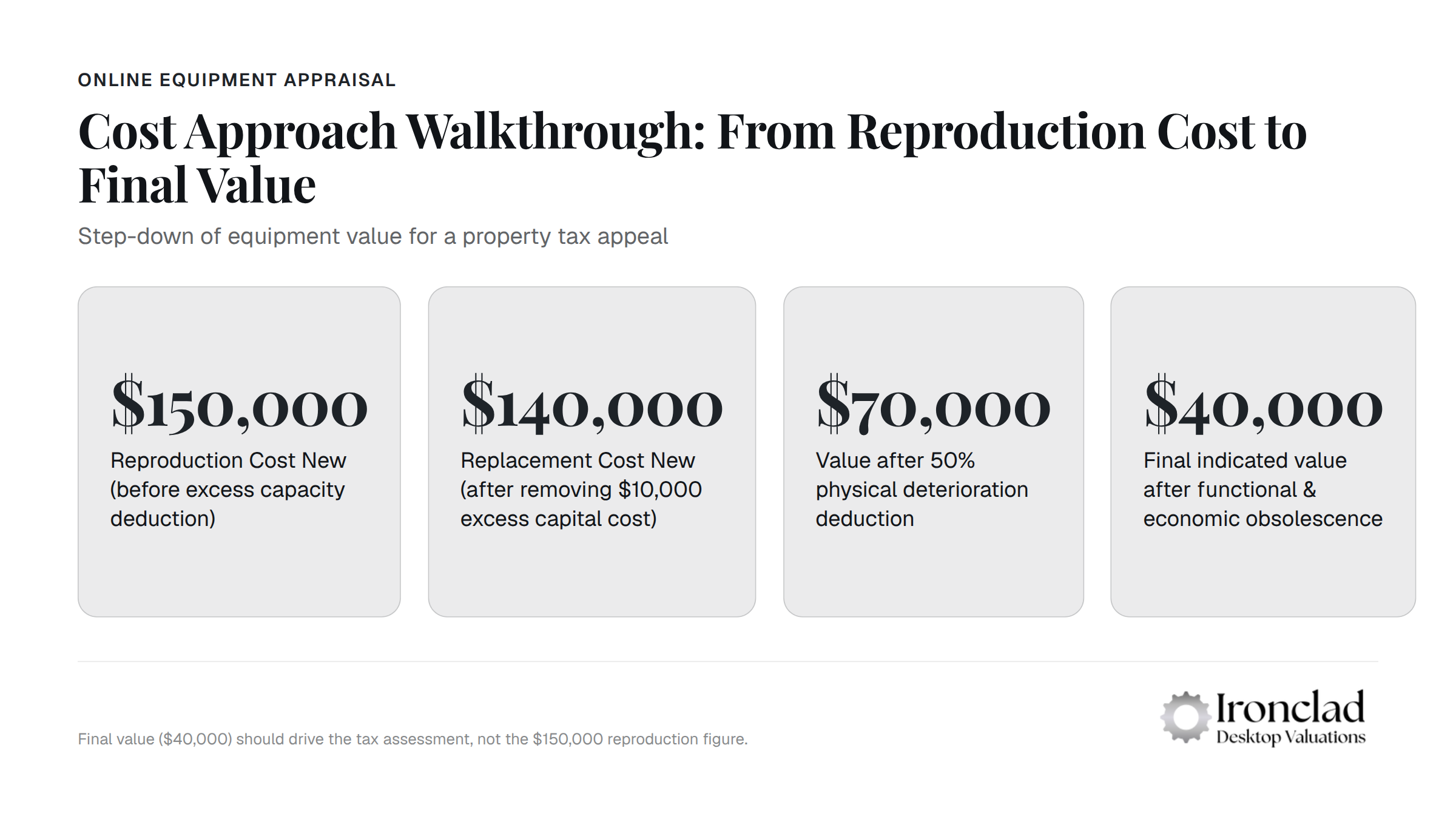
Suppose a piece of industrial equipment has a reproduction cost new of $150,000, but $10,000 of that reflects excess capacity the business doesn't actually use. The calculation runs as follows:
- Reproduction Cost New: $150,000
- Less Excess Capital Cost: -$10,000
- Replacement Cost New: $140,000
- Less Physical Deterioration (50%): -$70,000
- Value after physical deterioration: $70,000
- Less Functional Obsolescence (20%): -$14,000
- Value after functional obsolescence: $56,000
- Less Economic Obsolescence: -$16,000
- Final indicated value: $40,000
That final $40,000 is the number that should be driving the tax assessment, not the $150,000 reproduction figure or a flat percentage knocked off a generic table. If the assessor's roll shows this equipment closer to $70,000 or $80,000, the physical deterioration and obsolescence deductions are the exact place to focus an appeal.
How Depreciation Schedules Are Built, and Why They Go Stale
Assessors don't usually calculate physical deterioration and obsolescence asset by asset. Instead, they build a depreciation schedule: a table that groups equipment by type, age, and sometimes manufacturer, then applies a single depreciation multiplier to every asset in that group.
Those multipliers come from analyzing used-equipment sales data over time. An analyst tracks how resale prices for a category of machinery decline as the equipment ages, plots that decline into a trend line, and turns the trend line into a percentage-off-cost figure for each age bracket. It's a reasonable approach for valuing thousands of assets efficiently, but it has two structural weaknesses that make it a common target in appeals.
First, the underlying sales data can go stale. A schedule built five or ten years ago may not reflect how a particular equipment category is actually trading today, especially in categories where technology or demand has shifted quickly.
Second, schedules group by broad categories that don't always match the actual asset. A schedule built for general manufacturing equipment applied to a specialized, heavily used, or heavily modified piece of machinery can produce a value that has little to do with that specific asset's condition.
Watch out: if an assessment relies on a depreciation schedule that hasn't been updated in several years, or that lumps your equipment into a category broader than its actual use case, that mismatch is grounds to challenge the number directly.
The Market Approach: Why Comparable Sales Carry the Most Weight
When a cost-derived schedule value looks too high, the strongest rebuttal is usually not another cost calculation. It's evidence of what similar equipment has actually sold for.
The market approach, also called sales comparison, looks at recent transactions involving comparable used equipment: same type, similar age, similar condition, similar capacity. Many state valuation manuals give market evidence primary weight over cost-derived figures whenever adequate comparable sales data exists, because actual transactions reflect what buyers and sellers are agreeing to pay right now, not a formula's estimate of decline.
Example: if a cost approach recalculation points to $40,000, but three verified sales of comparable equipment in the same condition class recently closed between $34,000 and $38,000, that sales evidence strengthens the appeal considerably. A hearing officer weighing a formula against actual transaction data will usually lean toward the transactions.
Common Grounds for a Successful Equipment Tax Appeal
Most successful appeals rest on one or more of the following issues:
- An outdated or mismatched depreciation schedule: the multiplier applied doesn't reflect current used-equipment market data or groups the asset into too broad a category.
- Unaccounted-for functional or economic obsolescence: new regulatory requirements, emissions standards, or declining demand for the equipment's output have reduced its value in ways the assessor's flat schedule doesn't capture.
- An incorrect original cost basis: the reported acquisition cost used as the starting point for depreciation is wrong, inflated, or includes costs that shouldn't be capitalized into the equipment's value.
- Disposed or double-counted assets: equipment that has been sold, scrapped, or retired is still sitting on the rendered asset list, or the same asset is counted twice across categories.
None of these grounds work as a bare assertion that the tax bill feels too high. Each one needs to be demonstrated with a recalculated cost approach, supporting market data, or corrected records, which is exactly what a formal appraisal report provides.
Building a Defensible Appeal
A persuasive equipment property tax appeal pairs a USPAP-compliant cost approach recalculation with real market evidence, not one or the other alone. The cost approach shows the assessor's math is wrong on its own terms; the market approach shows what buyers are actually paying. Together they give a board of equalization or hearing officer two independent reasons to agree with your number.
Our appraisers hold credentials with organizations including the ASA, CAGA, and NEBB, and every equipment appraisal we prepare follows USPAP so it can stand up to scrutiny at any stage of the protest process, from an informal conversation with the assessor's office through a formal hearing. Fees for these engagements are quoted as a fixed amount after we scope the assignment, based on factors like the number of assets involved, the completeness of existing records, and the depth of analysis the appeal requires; for machinery and equipment appraisals, typical engagements run from $695 to $3,000, with more complex, high-asset-count portfolios running higher. You can review our full equipment appraisal pricing and see how our appraisal process works before requesting a report.
This article is provided for general informational purposes only and does not constitute legal, tax, or financial advice. Readers should consult a qualified attorney or CPA regarding their specific circumstances.