
Blog
How an Equipment Insurance Appraisal Dispute Gets Resolved When Values Collide
When an insurer and a policyholder can't agree on what a damaged or stolen machine is worth, the appraisal clause in the policy supplies a binding path forward. Here's how the two-appraiser, one-umpire process actually works, and what it can't decide.
A disagreement over the value of a damaged CNC machine, a destroyed tractor, or a stolen fleet of diagnostic equipment does not have to end in a lawsuit. Most commercial property policies include an appraisal clause built for exactly this situation: a structured, binding way to settle the dollar amount of a loss without litigating the whole claim. This differs from the appraisal that produced the insurer's or policyholder's original number. It is a separate, second-stage process that only activates once both sides have already looked at the same equipment and landed on different figures.
Our team regularly supports policyholders and attorneys through this stage of an equipment insurance claim, serving as the competent, impartial appraiser the clause requires. Understanding how the process unfolds, and where its authority stops, helps you decide whether invoking it is the right move.
What Triggers the Appraisal Clause
The appraisal clause activates when both parties agree the loss is covered but disagree on the amount, whether that's actual cash value (ACV), replacement cost, or the cost to repair. It is not a tool for arguing that a loss should be covered at all. Industry legal commentary consistently draws this line: appraisal settles the number, not whether the number is owed in the first place (The Appraisal Process, Property Insurance Coverage Law).
Either party can invoke the clause once negotiations stall. In practice, that usually happens after an insurer's adjuster and a policyholder's own estimate diverge enough that further back-and-forth isn't productive. For equipment losses specifically, this often comes down to a dispute over what counts as a true replacement machine, how much depreciation applies, or whether a repair estimate actually restores the equipment to its pre-loss function.
The Written Demand and Timelines
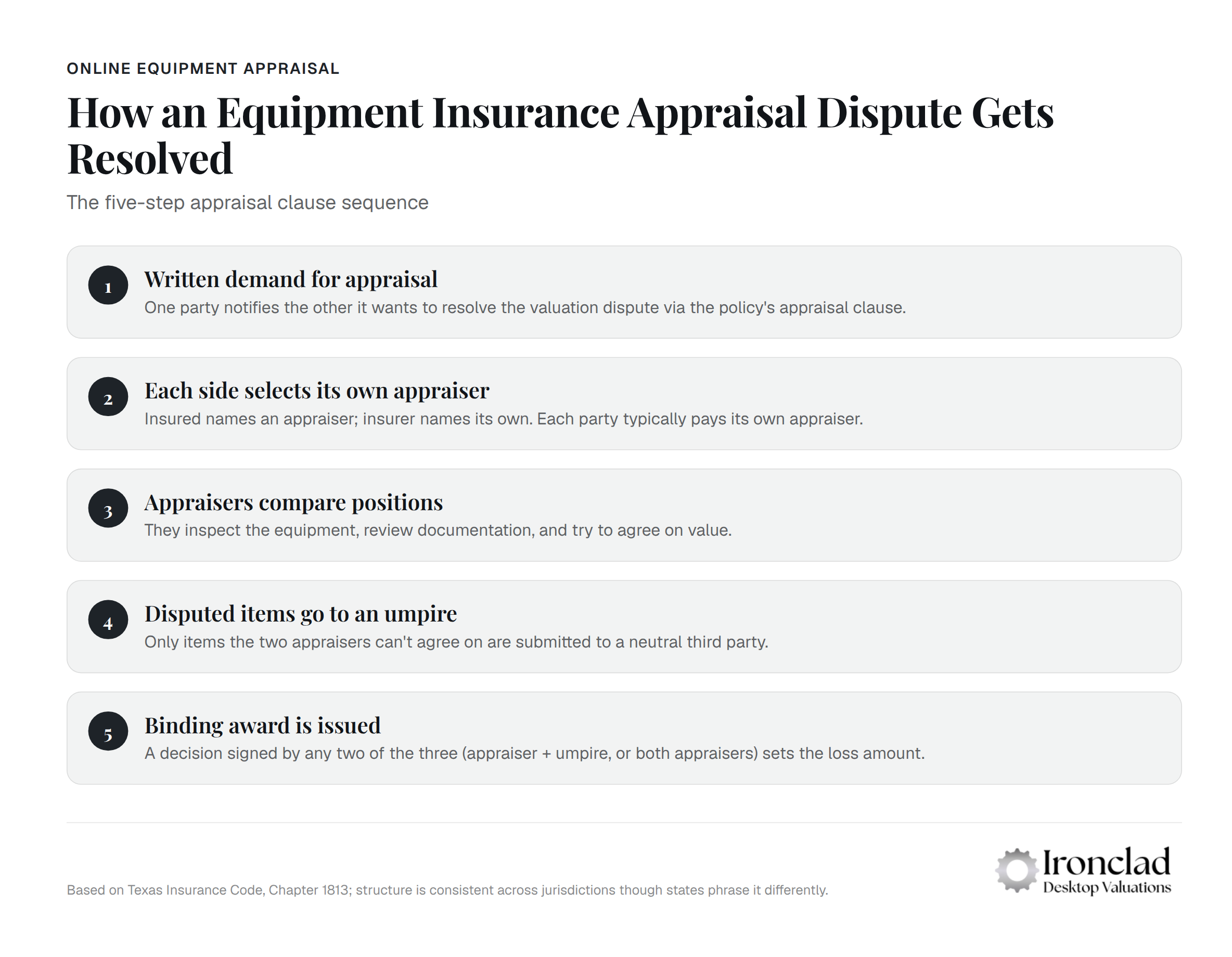
Invoking appraisal starts with a written demand from one party to the other. The demand identifies the clause being invoked and the items in dispute. From there, the process generally follows a set sequence:
- Written demand for appraisal. One side notifies the other that it wants to resolve the valuation dispute through the policy's appraisal clause rather than continued negotiation or litigation.
- Each side selects its own appraiser. The insured names an appraiser; the insurer names its own. Each party typically pays for its own appraiser.
- The two appraisers compare positions. They inspect the equipment, review documentation, and attempt to agree on value.
- Disputed items go to an umpire. Where the two appraisers can't agree, only the items still in dispute are submitted to a neutral third party.
- A binding award is issued. A decision signed by any two of the three (either appraiser plus the umpire, or both appraisers) determines the submitted valuation questions.
Texas law, as one example of how states codify this, requires certain policies to include an appraisal provision and limits its use to determining the amount of loss once that amount is disputed (Texas Insurance Code, Chapter 1813). Other states phrase it differently, but the structure is consistent across jurisdictions.
Selecting a Competent, Impartial Appraiser
The clause requires each side to choose an appraiser who is both competent and impartial, meaning someone qualified to value the specific asset class and free of a financial stake in the outcome. For equipment claims, that typically means an appraiser with hands-on experience valuing machinery, understanding depreciation schedules, and reading manufacturer specifications, not a generalist adjuster.
Our appraisers bring credentials relevant to equipment and machinery valuation, including training recognized by the International Society of Appraisers (ISA) and the American Society of Appraisers (ASA), and we prepare our work in accordance with the Uniform Standards of Professional Appraisal Practice (USPAP). That standards framework matters here because an award built on a defensible, well-documented valuation methodology is far less likely to be challenged later.
Pro tip: Choose an appraiser who has valued your specific equipment category before. A CNC machine, a combine, and a diagnostic imaging unit depreciate on very different curves, and an umpire will weigh an appraiser's documented reasoning more heavily than a bare number.
How the Two Appraisers Try to Agree
Once both appraisers are engaged, they inspect the equipment (or review documentation if the equipment was destroyed or stolen) and develop independent valuation positions. This typically draws on purchase records, maintenance history, comparable sales, manufacturer pricing, and, for damaged equipment, repair estimates from qualified repair sources. A current property-insurance valuation guide identifies the cost approach as the generally accepted method for machinery and equipment, commonly expressed as either replacement cost new or actual cash value (BHSI, Engaging an Appraisal for Insurable Property Value).
The two appraisers then compare positions directly. Many disputes narrow quickly once each side sees the other's documentation, since a gap is often driven by a disagreement over one or two inputs (which comparable machine counts as equivalent, or how much functional obsolescence to apply) rather than a wholesale disagreement about methodology. Where they do agree, that figure is final. Where they don't, only the specific disputed items move forward, not the entire claim.
What the Appraisers Are Actually Valuing
For equipment claims, the appraisers are typically asked to resolve some combination of:
- Actual cash value: replacement cost new less physical and functional depreciation, as defined by the policy.
- Replacement cost: the cost to replace the equipment with new equipment of like kind and quality, or the nearest equivalent utility.
- Repair cost: whether the equipment can be economically restored, and what that restoration costs.
- Salvage value: what a damaged or decommissioned unit is realistically worth if retained or sold.
Replacement cost is not simply the original purchase price restated. It reflects current pricing, freight and installation, and whether a truly comparable model is still available, which is exactly the kind of input that two appraisers can reasonably value differently.
When the Appraisers Can't Agree: the Umpire
If the two appraisers reach an impasse on one or more items, they jointly select a neutral umpire. The umpire's job is narrower than it sounds: only the specific items still in dispute are submitted, not the whole claim, and not anything the two appraisers already agreed on. If the appraisers can't agree on who the umpire should be, the policy or state law typically allows a court to appoint one. Puerto Rico's insurance regulations, for instance, require the appraisers to hold initial meetings and make a good-faith effort to resolve discrepancies before escalating to that step (Puerto Rico Insurance Code Regulations, Rule 20106).
The umpire reviews the same categories of evidence the appraisers used (manufacturer data, comparable sales, condition records, repair estimates) and issues a determination on the disputed items only. A sample appraisal protocol published by the American Bar Association notes that a well-constructed award should separately state both the actual cash value and the replacement cost of the items appraised, rather than collapsing them into a single figure (ABA, Appraisal Article Appendix Forms). That separation matters because many policies pay replacement cost only after the insured actually repairs or replaces the equipment, with ACV serving as an initial or fallback figure.
The Binding Two-of-Three Award
An award signed by any two of the three participants, typically one appraiser plus the umpire, becomes binding on the valuation questions submitted. This is the mechanism that gives appraisal its teeth: neither side can simply reject a number it dislikes once two of the three sign off.
Courts have historically limited their review of these awards to narrow grounds such as fraud, corruption, evident partiality, procedural unfairness, or a failure to follow the governing policy or statute (Property Insurance Coverage Law, The Appraisal Process: An Outline). A Canadian court interpreting a similarly worded statutory condition confirmed that an appraisal panel's authority stops at determining the value of the property, the property saved, and the amount of the loss (isthatlegal.ca, Umpire Appraisals).
Key takeaway: The award is binding, but only on the dollar figure. It does not reopen or resolve whether the claim was covered in the first place.
What Appraisal Does Not Resolve
It's worth being direct about the limits here, because policyholders sometimes expect more finality than the clause provides. Appraisal does not decide:
- Whether the loss is covered under the policy at all.
- Whether a specific exclusion applies to the equipment or the cause of loss.
- Whether the insured complied with post-loss duties, such as notice or proof-of-loss deadlines.
- Whether the insurer acted in bad faith in handling the claim.
- Whether policy limits, deductibles, or coinsurance penalties apply to the award once it's issued.
Texas law makes this explicit: invoking the statutory appraisal clause does not affect any other applicable policy terms (Texas Insurance Code, Chapter 1813). In practical terms, that means a policyholder can win a strong ACV number through appraisal and still have to separately argue a coverage dispute with the same insurer. The two tracks run independently.
Worked Example: A Damaged CNC Machine
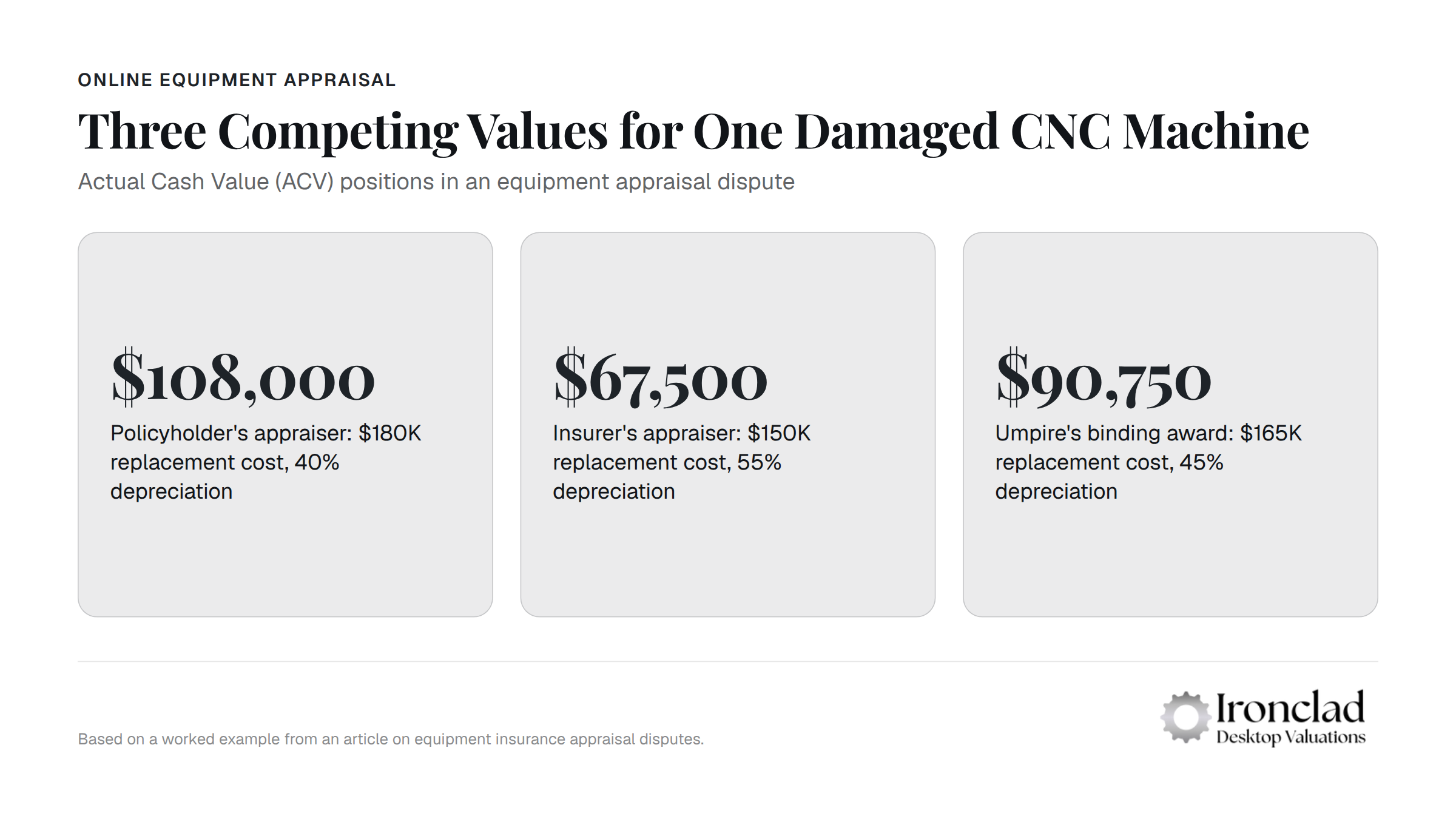
Consider a mid-size CNC milling machine damaged in a shop fire. The policyholder and insurer agree the loss is covered under the equipment's commercial property policy; they disagree sharply on what it's worth.
| Position | Replacement Cost New | Depreciation Applied | Resulting ACV |
|---|---|---|---|
| Policyholder's appraiser | $180,000 | 40% (based on a directly comparable current model) | $108,000 |
| Insurer's appraiser | $150,000 | 55% (based on an older, lower-spec comparable) | $67,500 |
| Umpire's determination | $165,000 | 45% | $90,750 |
The policyholder's appraiser priced a current-generation machine with equivalent spindle speed and tooling capacity, applying depreciation based on the unit's maintenance records and moderate usage. The insurer's appraiser selected an older reference model as the comparable and applied a steeper depreciation rate, reflecting the machine's age and a service gap in the maintenance log. Both positions agreed the machine was a repairable total economic loss (repair cost exceeded replacement cost), but they disagreed on exactly which replacement unit was the right benchmark and how much obsolescence to apply.
Only those two disputed inputs, the comparable model selection and the depreciation rate, went to the umpire. The umpire reviewed current manufacturer pricing for a mid-spec equivalent, the shop's maintenance history, and comparable used-equipment sales, then set replacement cost at $165,000 with 45% depreciation, producing an ACV of $90,750. That figure, signed by the umpire and one of the two appraisers, became the binding award. Coverage, the deductible, and how the insurer applied coinsurance to the claim were handled separately and were never part of the appraisal.
How This Differs From the Original Claim Appraisal
It's easy to conflate this process with the appraisal that produced the insurer's or policyholder's initial number, but they serve different purposes. The first appraisal estimates what the equipment is worth for purposes of the claim submission. The appraisal clause process only exists because that first round of estimates didn't match, and it exists specifically to resolve the disputed figures through a structured, binding mechanism rather than negotiation or litigation. If you're earlier in the process and haven't yet reached a disagreement, our guide on replacement cost versus actual cash value for equipment walks through how those two valuation standards are built before a dispute ever arises.
What This Engagement Costs
Appraisal-clause representation is a distinct, scoped engagement from a standard equipment valuation. Because the scope depends on how many items are actually disputed, the complexity of the equipment, and whether the matter proceeds to an umpire, we quote this work as a fixed fee after reviewing the dispute, never on an hourly basis. There's no standard rate card for this stage of the process because every disputed claim arrives with a different number of contested items and a different volume of documentation to review.
Getting the Right Appraiser on Your Side
An appraisal clause gives both sides a faster, less expensive alternative to litigating the value of a damaged or destroyed machine, but it only works as well as the appraiser representing you. A competent, impartial appraiser with real equipment experience, not a generalist adjuster, gives your position the documentation and methodology it needs to hold up through comparison and, if necessary, in front of an umpire.
If you're facing a valuation dispute on a covered equipment loss, our team can serve as your appraiser under the policy's clause or prepare the underlying valuation your attorney needs to invoke it. Visit our equipment insurance claim appraisal services page to get a scoped engagement started.
This article is provided for general informational purposes only and does not constitute legal, tax, or financial advice. Readers should consult a qualified attorney regarding their specific policy and dispute.