
Blog
What the IRS Requires for a Qualified Appraisal of Donated Equipment
A qualified appraisal for donated equipment is required once the claimed deduction passes $5,000, and getting the appraiser, timing, and Form 8283 details wrong can cost you the entire write-off. This guide walks through the IRS rules step by step, with a worked example for a donated forklift.
Donating a forklift, tractor, or piece of manufacturing machinery to a nonprofit or trade school can generate a real tax benefit, but the IRS does not take your word for the value. Once the claimed deduction for donated equipment crosses $5,000, federal law requires a qualified appraisal prepared by a qualified appraiser, not a used-equipment listing or a dealer's quote. This guide walks through the threshold, the appraiser qualifications, the timing rule, and the Form 8283 paperwork so your deduction survives IRS review. AIN prepares equipment appraisals for charitable donation built to meet these exact requirements.
When Does Donated Equipment Require a Qualified Appraisal?
A qualified appraisal is required whenever the claimed deduction for an item of equipment, or a group of similar items given to one or more donees, exceeds $5,000. Below that threshold, a receipt and a reasonable valuation method are enough. Above it, the Form 8283 instructions require a written appraisal that meets specific content and signature standards, summarized in Section B of the form.
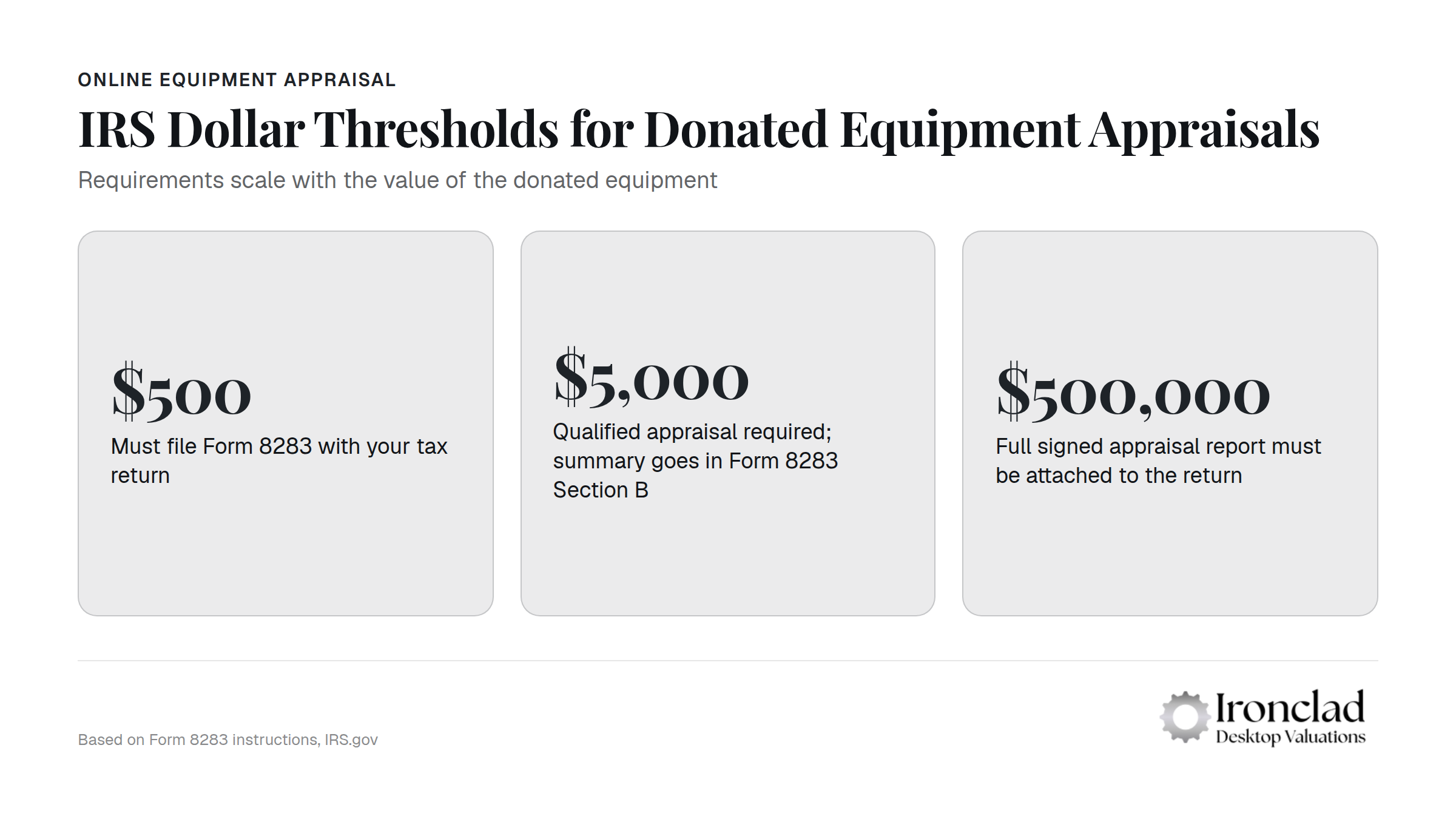
The rule scales with the size of the gift:
- Over $500 in total noncash contributions for the year: you must file Form 8283 with your return, even if no appraisal is needed yet.
- Over $5,000 for a single piece of equipment or a group of similar items (a matched set of shop tools, several tractors donated to the same charity): a qualified appraisal is required, and the summary goes in Form 8283 Section B.
- Over $500,000 for an item or group of similar items: the full signed appraisal report must be attached to the return, not just the Form 8283 summary.
Donated farm and agricultural equipment falls squarely into this framework. A used combine, baler, or irrigation system donated to an agricultural college or 4-H program is treated the same as any other piece of industrial equipment for appraisal purposes. AIN's online farm equipment appraisal service is built around exactly this scenario.
Who Counts as a Qualified Appraiser?
The IRS defines a qualified appraiser narrowly, and the definition matters because an appraisal from the wrong person is not a qualified appraisal at all, no matter how thorough it is. Under Treasury Regulation 1.170A-17, a qualified appraiser must meet education and experience standards specific to the type of property being valued, follow generally accepted appraisal standards, and regularly perform appraisals for compensation.
In practice, that means the appraiser valuing your donated equipment needs to show one of two paths:
- A recognized appraisal designation, such as those issued by the American Society of Appraisers or similar organizations, that covers machinery and equipment valuation, or
- Verifiable education plus experience, generally at least two years actively valuing the specific type of equipment involved, combined with a demonstrated, ongoing appraisal practice.
The appraiser also cannot be the donor, the donee organization, an employee of either, or anyone related to the transaction in a way that compromises independence. A regulatory notice issued after the Pension Protection Act of 2006 spelled out these disqualification rules and confirmed that a person barred from practicing before the IRS in the prior 3 years cannot serve as a qualified appraiser, as detailed in IRS Notice 2006-96. Our appraisers complete equipment valuations online through a documented desktop equipment appraisal process built around this exact standard.
Pro tip: Ask any appraiser upfront whether they have valued your specific equipment category before. A generalist personal property appraiser without machinery experience does not meet the bar, even with an active credential in a different specialty.
Timing: When the Appraisal Must Be Completed
The appraisal does not need to happen before you donate the equipment; it needs to happen before you file. Under Treas. Reg. 1.170A-17, the appraisal must be dated no earlier than 60 days before the contribution date, and it must be received by the taxpayer no later than the due date, including extensions, of the return on which the deduction is first claimed.
That gives donors a wider window than most assume. If you donate a tractor in March and file for an extension to October, you have until October to get the appraisal in hand, as long as the appraisal itself is not backdated before that 60-day pre-donation window. If the deduction is first claimed on an amended return, the appraisal must be received before the amended return is filed.
Watch out: Waiting until audit time to obtain an appraisal is too late. The appraisal must already exist and be dated correctly by the time you file the return claiming the deduction, not produced afterward to justify a number you already wrote down.
What Form 8283 Section B Requires (and Who Signs It)
Section B of Form 8283 is the reporting mechanism for any donated equipment valued over $5,000, and it requires signatures from three separate parties before the IRS will accept it. The Form 8283 instructions walk through each part of the section in detail.
| Party | What they provide | Section |
|---|---|---|
| Donor | Description of the equipment, how and when it was acquired, cost basis, and the appraised fair market value | Part I |
| Qualified appraiser | Signature, declaration, appraiser qualifications, and the appraised value they certified | Part III |
| Donee organization | Acknowledgment that the property was received, signed by an authorized official | Part IV |
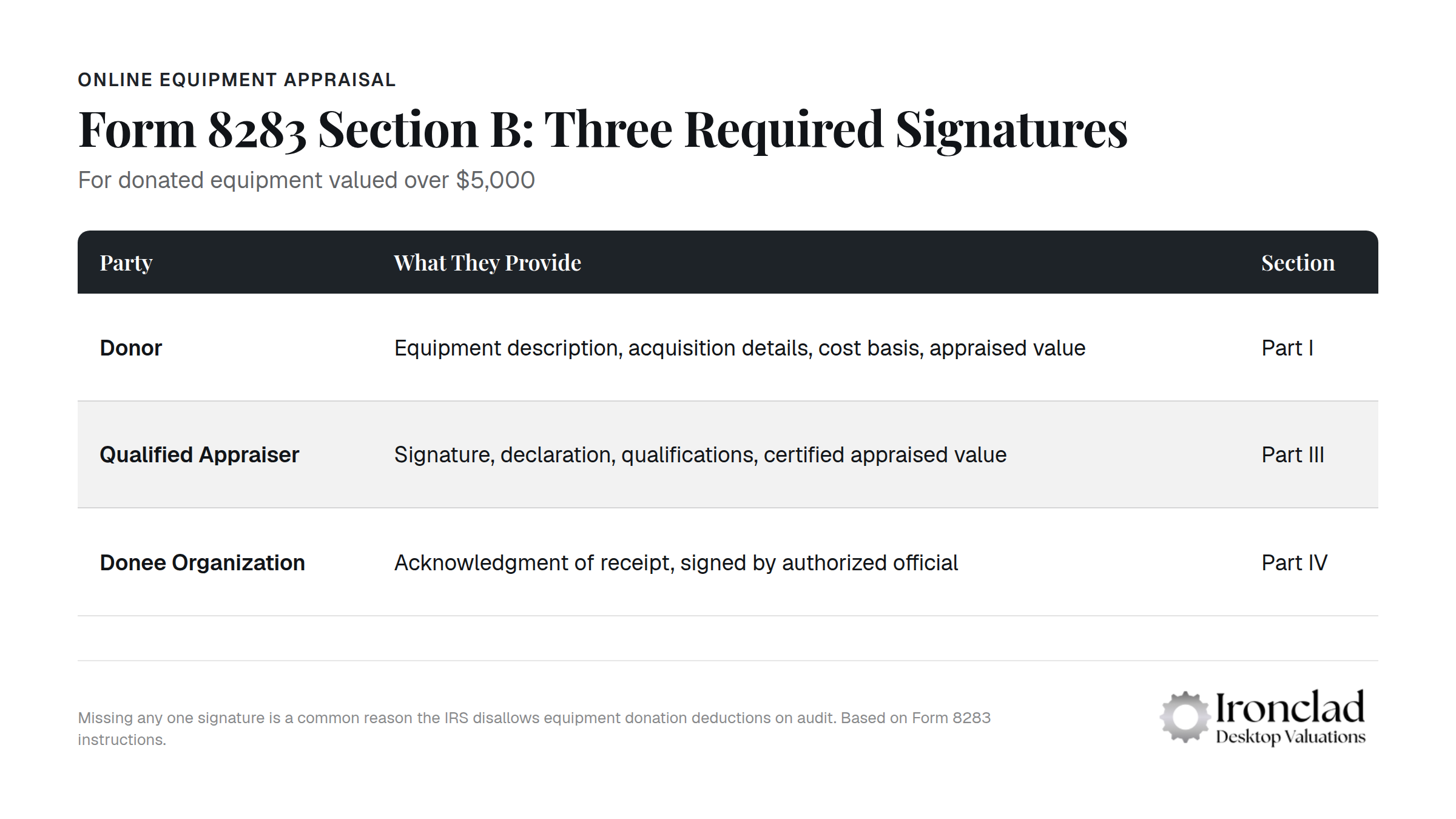
Missing any one of these three signatures is one of the most common reasons the IRS disallows an equipment donation deduction on audit. The donor cannot self-certify the appraiser's declaration, and the donee's signature only acknowledges receipt of the property; it does not endorse the value.
The $500,000 Attachment Rule (and Why It Doesn't Change for Equipment)
A separate rule requires attaching the entire signed appraisal report, not just the Form 8283 summary, once a deduction passes a much higher threshold. As the Form 8283 instructions state:
"If you are claiming a deduction of more than $500,000 for an item (or group of similar items) donated to one or more donees, you must attach the qualified appraisal of the property to your return unless an exception applies."
Some donors confuse this with a separate, lower $20,000 rule that applies specifically to donated art, which requires attaching the full appraisal at a much smaller dollar amount. That $20,000 art rule does not apply to equipment. For machinery, farm equipment, and other industrial assets, the $500,000 threshold is the one that triggers a mandatory full attachment; below it, the Form 8283 summary is sufficient to keep on file.
What Makes an Equipment Appraisal Defensible
A qualified appraisal that technically checks every regulatory box can still fall apart under IRS scrutiny if the underlying work is thin. A defensible equipment appraisal combines regulatory compliance with genuinely sound valuation practice.
Look for these elements in any report before you rely on it:
- USPAP compliance: The appraisal should be prepared in accordance with the Uniform Standards of Professional Appraisal Practice, the standard referenced directly in the Form 8283 instructions and in Treas. Reg. 1.170A-17's definition of generally accepted appraisal standards.
- Documented fair market value methodology: The report should state whether it relies on comparable sales, a cost-less-depreciation approach, or another recognized method, and should explain why that method fits the equipment type.
- Physical inspection or a documented condition assessment: Even for a remote or desktop appraisal, the report needs enough condition detail, photos, hour meter readings, maintenance history, to support the value assigned.
- Make, model, and serial number detail: Generic descriptions like "used tractor" invite challenge. The report should identify the specific unit precisely enough that a knowledgeable reader could locate the same asset in the market.
- A clear statement of intended use: The report should state plainly that it was prepared for charitable contribution substantiation under IRC Section 170, not for insurance, financing, or resale purposes.
Worked Example: Donating a Used Forklift
A small manufacturing company decides to donate a used 5,000-pound capacity forklift to a vocational trade school. The forklift is 8 years old, has roughly 6,200 hours on the meter, and is in working condition with some cosmetic wear.
The company's controller reaches out to a qualified appraiser with documented experience valuing industrial material-handling equipment. The appraiser inspects photos and maintenance records, researches recent sales of comparable forklifts in similar condition and hour ranges, and applies a sales-comparison approach adjusted for hours and condition. The appraiser concludes a fair market value of $7,800 as of the donation date.
Here is how that flows through the paperwork:
- Donation date: The company transfers the forklift to the trade school on June 15.
- Appraisal window: The appraiser can date the report anytime from April 16 (60 days before) through the extended filing deadline for the company's return.
- Form 8283 Section B: Because the deduction exceeds $5,000, the company completes Section B, describing the forklift by make, model, and serial number, and listing the $7,800 appraised value.
- Signatures: The appraiser signs Part III, certifying the valuation and their qualifications. The trade school's authorized representative signs Part IV, acknowledging receipt.
- Filing: The company attaches the completed Form 8283 to its return. Since the deduction is well under $500,000, the full appraisal report is not attached but is kept on file in case the IRS requests it later.
Had the company instead donated an entire fleet of forklifts to the same school with a combined value well past $500,000, the full signed appraisal would need to be attached to the return, not just the Form 8283 summary.
Protecting the Deduction Before You File
The equipment appraisal rules are unforgiving about process: the right appraiser, the right timing, and the right signatures matter as much as the number itself. A qualified appraisal that skips any of these steps risks the entire deduction on audit, regardless of how accurate the value turns out to be. Getting the report built correctly from the start, with USPAP-consistent methodology and complete equipment identification, is far cheaper than reconstructing one after the IRS raises questions.
AIN prepares fixed-fee, IRS-qualified equipment appraisals for charitable donations of machinery, farm equipment, and industrial assets, with reports built to satisfy Treas. Reg. 1.170A-17 and Form 8283 requirements from the outset. If you're planning an equipment donation this year, request an equipment appraisal before your filing deadline approaches so the paperwork is ready when you need it.
This article is provided for general informational purposes only and does not constitute legal, tax, or financial advice. Readers should consult a qualified attorney or CPA regarding their specific circumstances.